

Many children learning French in immersion programs or at home can recognize prepositions like in (dans), on (sur), under (sous), behind (derrière), and between (entre)… but struggle to use them naturally.
Parents often describe the same pattern: the words seem “known” during practice, but disappear in real situations.
This is not a motivation issue or a memory issue. It is a method issue.
French prepositions are usually taught as vocabulary lists instead of spatial meaning. And when children learn language this way, they often learn translation rather than understanding.
That distinction changes everything.
The real reason French prepositions don’t stick
Prepositions of place are not vocabulary items.
They are spatial relationships.
To understand them, children must:
- visualize where something is
- connect that position to language
- process meaning in real time
- often switch between English and French
Words like dans, sur, sous, derrière, devant, and entre are not difficult on their own.
They become difficult when they are removed from context.
This is why children may succeed in worksheets but struggle in conversation.
They are not building meaning — they are translating.
And translation does not last.
The key shift that changes everything
The breakthrough happens when learning moves from explanation to repetition in context.
Instead of teaching prepositions as definitions, children need repeated exposure to the same simple structures inside changing visual situations.
A question like “Where is it?” (“Où est-ce que c’est ?”) becomes the anchor.
When that structure stays consistent but the position changes, children stop translating and start recognizing meaning directly.
That shift is what turns confusion into understanding.
A simple way to practice at home
This approach does not require preparation or teaching experience.
You can use any object in your home.
Place it somewhere visible and ask:
Where is it? Où est-ce que c’est ?”
Then change the position:
- inside a box (dans une boîte)
- on a chair (sur une chaise)
- under a table (sous une table)
- behind a curtain (derrière un rideau)
- in front of a sofa (devant un canapé)
- between two objects (entre deux objets)
What matters is not complexity.
It is repetition of the same language structure in different real-world contexts.
Over time, children begin to associate meaning directly with position instead of translation.
And that is when French starts to feel natural.
What parents usually notice
With consistent exposure, children often begin to:
- respond faster without translating
- recognize sentence patterns
- understand meaning in real time
- use French more confidently in context
At that point, French stops feeling like something to decode.
It starts feeling familiar.
A structured way to support this learning
This same principle — repetition, visual context, and predictable language — is also what structured story-based learning is built on.
Instead of teaching prepositions as isolated grammar rules, children learn through simple bilingual stories where a consistent character and object move through everyday situations.
The language stays familiar, while the spatial context changes slightly each time.
This creates repeated exposure to the same structures in meaningful, easy-to-understand ways.
How the book supports this approach
To make this easier for parents to use consistently at home, we created a bilingual English–French picture book:
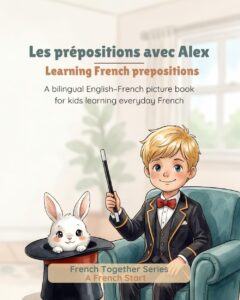
Les prépositions avec Alex / Learning French prepositions
It is designed specifically around the same learning principle described above.
Children follow a consistent character, Alex, through simple everyday scenes where French prepositions are used repeatedly in clear visual context.
The structure stays predictable, and only the positions change. This allows children to focus on meaning instead of translation.
How to use it at home
The book works best when it is interactive.
You can:
- pause and ask “Where is it?” (“Où est-ce que c’est ?”)
- let your child guess before turning the page
- reread pages to reinforce patterns
- repeat the same story multiple times
Repetition is not extra practice — it is the method.
When children mix English and French
This is completely normal.
Early on, many children will answer in English or mix both languages.
This does not mean they are not learning.
It usually means they are building understanding before producing consistent output.
At this stage, the goal is recognition, familiarity, and confidence — not perfection.
Bringing it all together
French prepositions do not become easier through memorization or explanation.
They become easier through repeated exposure in meaningful, visual context.
When language is consistent, predictable, and tied to real experience, children begin to understand it naturally instead of translating it.
That is the foundation behind this approach — and the reason story-based repetition is so effective for early French learners.